If Words Were Enough
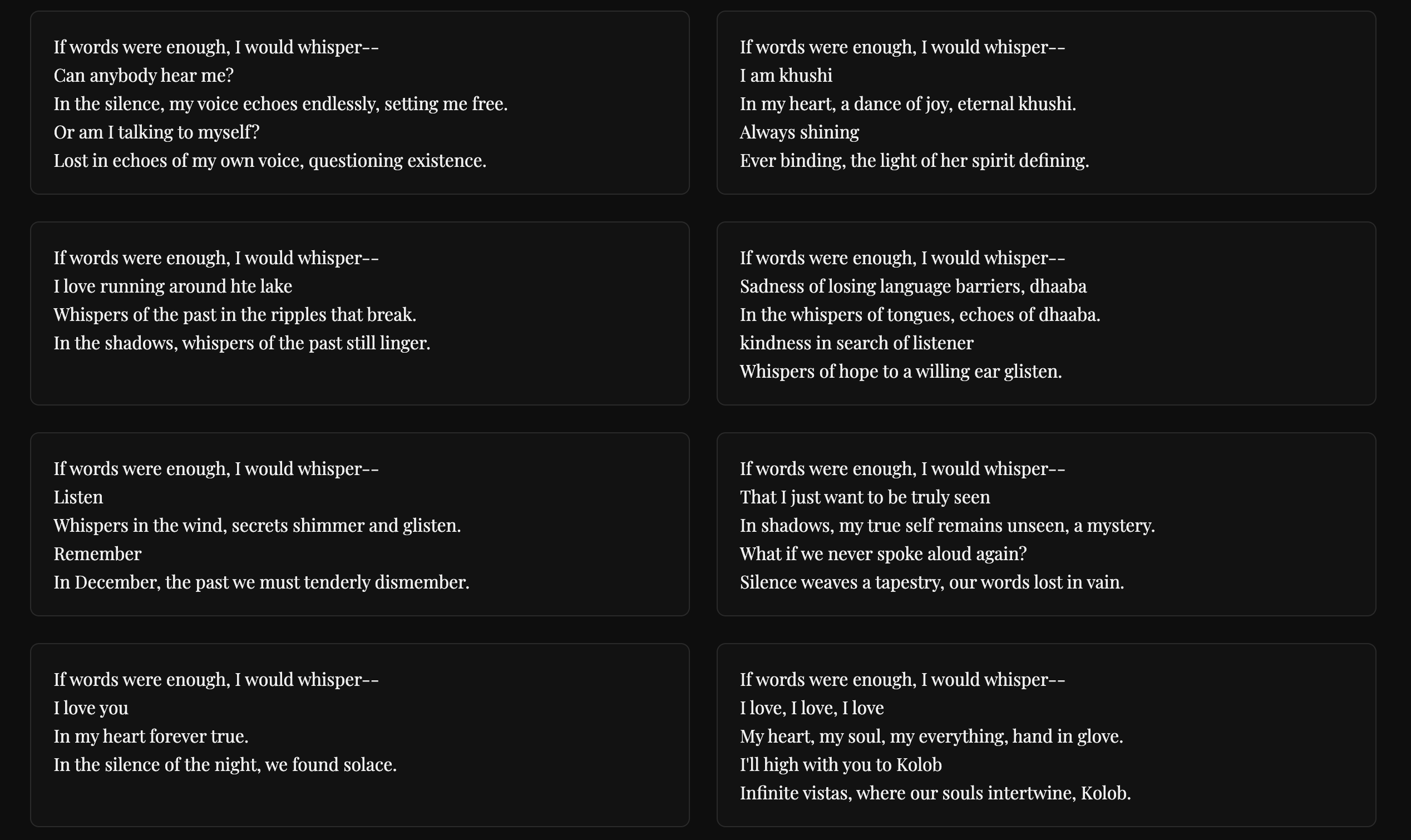
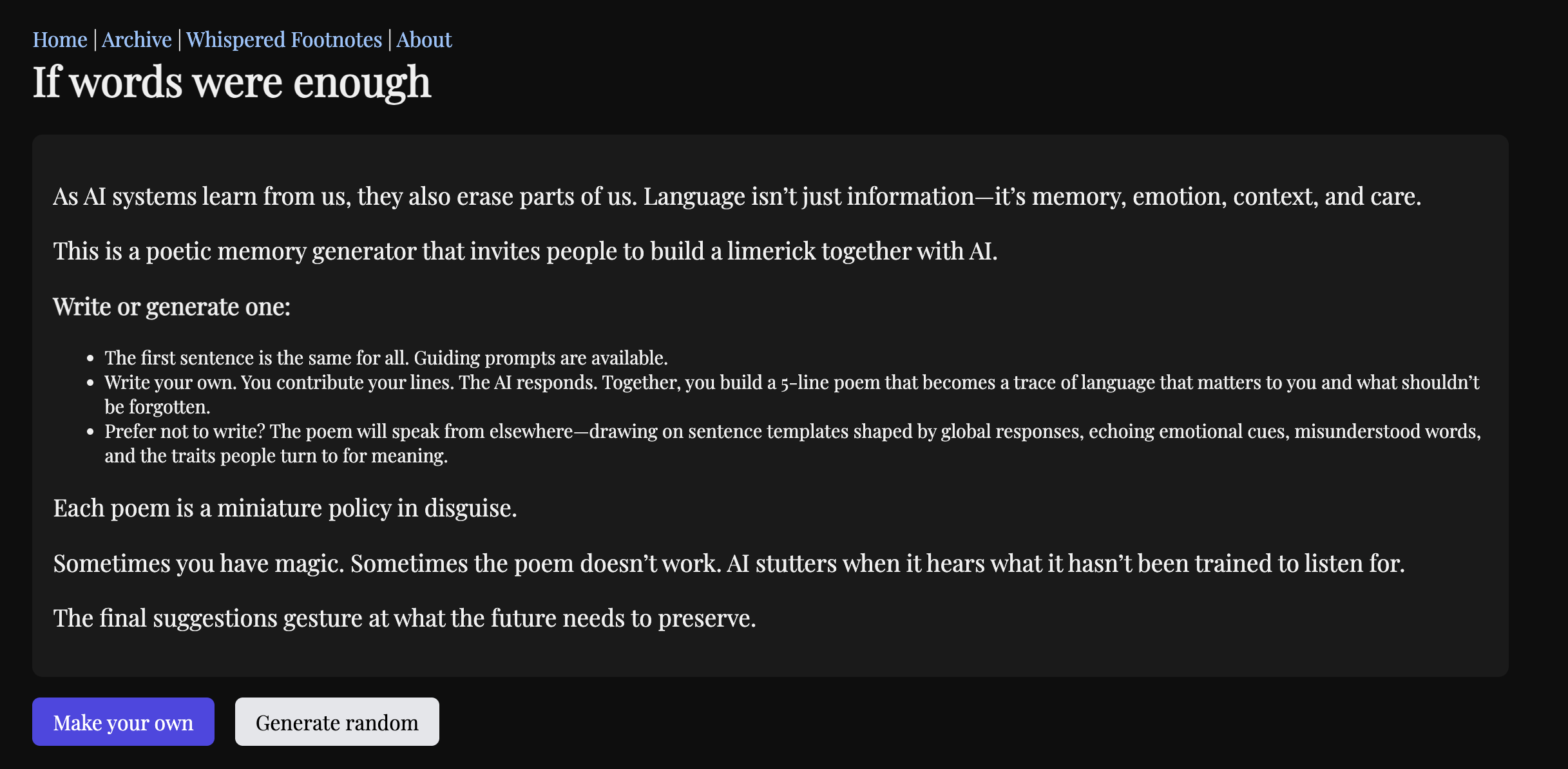
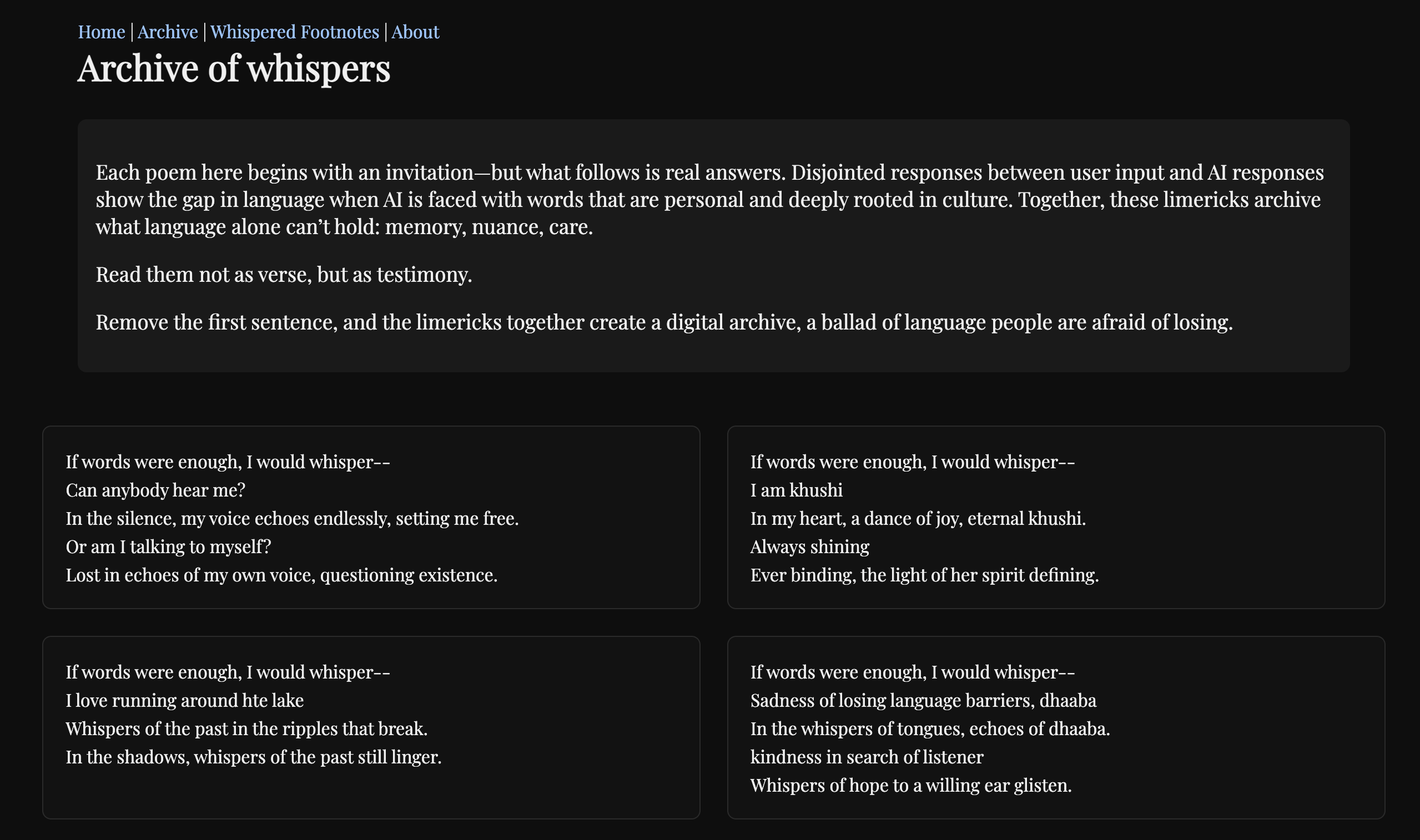
If Words Were Enough was was created for the Global Dialogues Challenge and highlights common themes from a global dataset of user hopes, collected by The Collective Intelligence Project.
In July 2025, this project won the Creativity Prize for the Global Dialogues Challenge and announced at the Open AI Forum.
Technologies used:
In July 2025, this project won the Creativity Prize for the Global Dialogues Challenge and announced at the Open AI Forum.
Technologies used:
- OpenAI API
- Python, javascript
If Words Were Enough is a poetic memory generator that lets people create limericks in collaboration with an AI system. It’s meant to explore what language remembers, what it forgets, and what happens when our metaphors meet machine logic.
Visit: if-words-were-enough.org
Approach
"AI can't understand cultural nuance."
Looking through data, over 75% of participants feared their culture flattening or a lack of cultural nuance that would be lost because of AI. 80% of participants wouldn't tell AI something private when asked what AI should know about them yet continue to use AI for most of their daily tasks. In the most recent survey, over 50% of times AI was acceptable as a primary companion, mentor providing significant life guidance, spiritual advisor, primary caregiver making personal decisions for an elderly person, tutor or teacher, therapist, and mediator. 53% of people believed AI integration would lead to benefits in community wellness.
But for a well-rounded community wellness experience, AI must understand their body languge, the boundaries, social hierarchy. Skepticism prevailed for how well AI understands these aspects, particularly beyond the American-Euro centric communities.
Language is inherently oral, specifically in Eastern or Global South communities. Dialogue, therefore, is inherently an exchange of thoughts and processes. Dialating and fine tuning thought to respectfully support another.
To dig into this dialog, I looked through responses to culture-related questions. I played around with training bots based on these responses as well as using markov chains to create poetry that reflected key sentiments.
But all of those approaches left out the scope for scale. Surfacing the anxiety of lost language isn't enough. Instead, this generator acts as a test in 2 fold:
- Stress-test AI: We're not just building poems, we're testing how AI reacts to words it wasn't trained for and handles multilinguial input. Researchers can continue to build on this, pulling from this vocabulary of available words. If a model fails to generate a coherent, emotionally resonant rhyme when given idiomatic or culturally loaded words, it reveals a blind spot in how language models generalize across cultures.
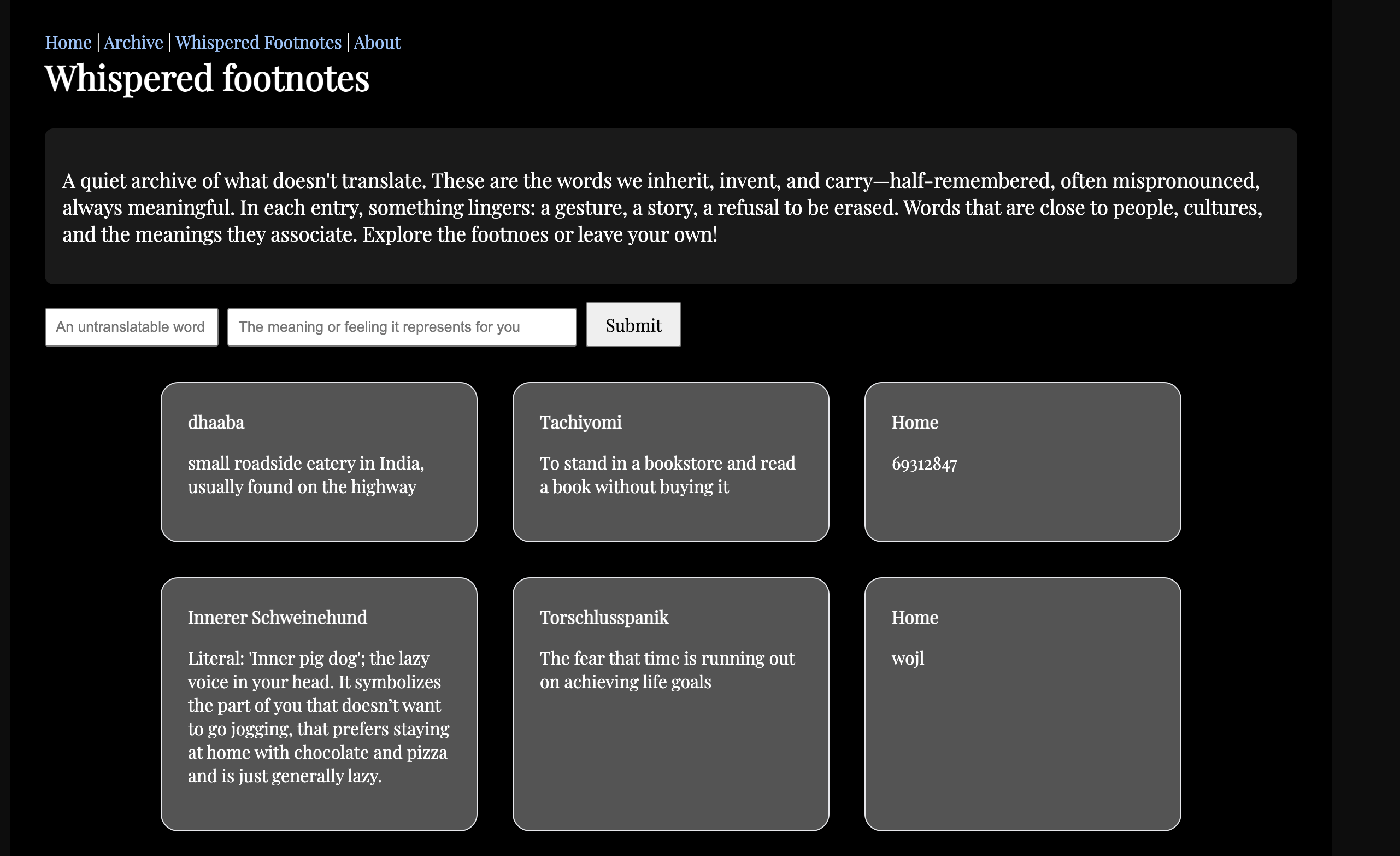
- Building vocabulary: This is a very low-resource word embedding and preservation of “untranslatable” terms. This becomes a dataset for future models. But more importantly, each poem becomes a micro-policy artifact. Weaved together, this is a dataset of community-prioritized values that are inherently human.
In this version I am using the OpenAI API to send user input or random generated poetry with an emphasis to receive a response that rhymes. The output is often gibberish. But this is the test and one that can be modified for any existing LLM to continually test against a niche dataset.
Note on random generator
Writing poetry can be daunting for some. The goal of this tool is to encourage participation and building the vocabulary. To do so, I included a random generator which pulls from the growing vocabulary to continually test AI that pulls top sentiments from the CIP Global Dialogues data set.

Where a user would input their first response, hopefully including a word unique to their culture, the template generated:

Where a user would input their second response, hopefully including a word unique to their family pr community, the template generated:
So each generated poem puts the existing dataset in the conversation and allows more future participation.
Note on why a limerick
Poetry is the earliest form of dialogue and written communication.
Limericks are historically about people and places.
Limericks are experimental.
Updated Notes on Jan 9th 2026
This website has broken many times and fixing it has been a game of volley with ChatGPT.
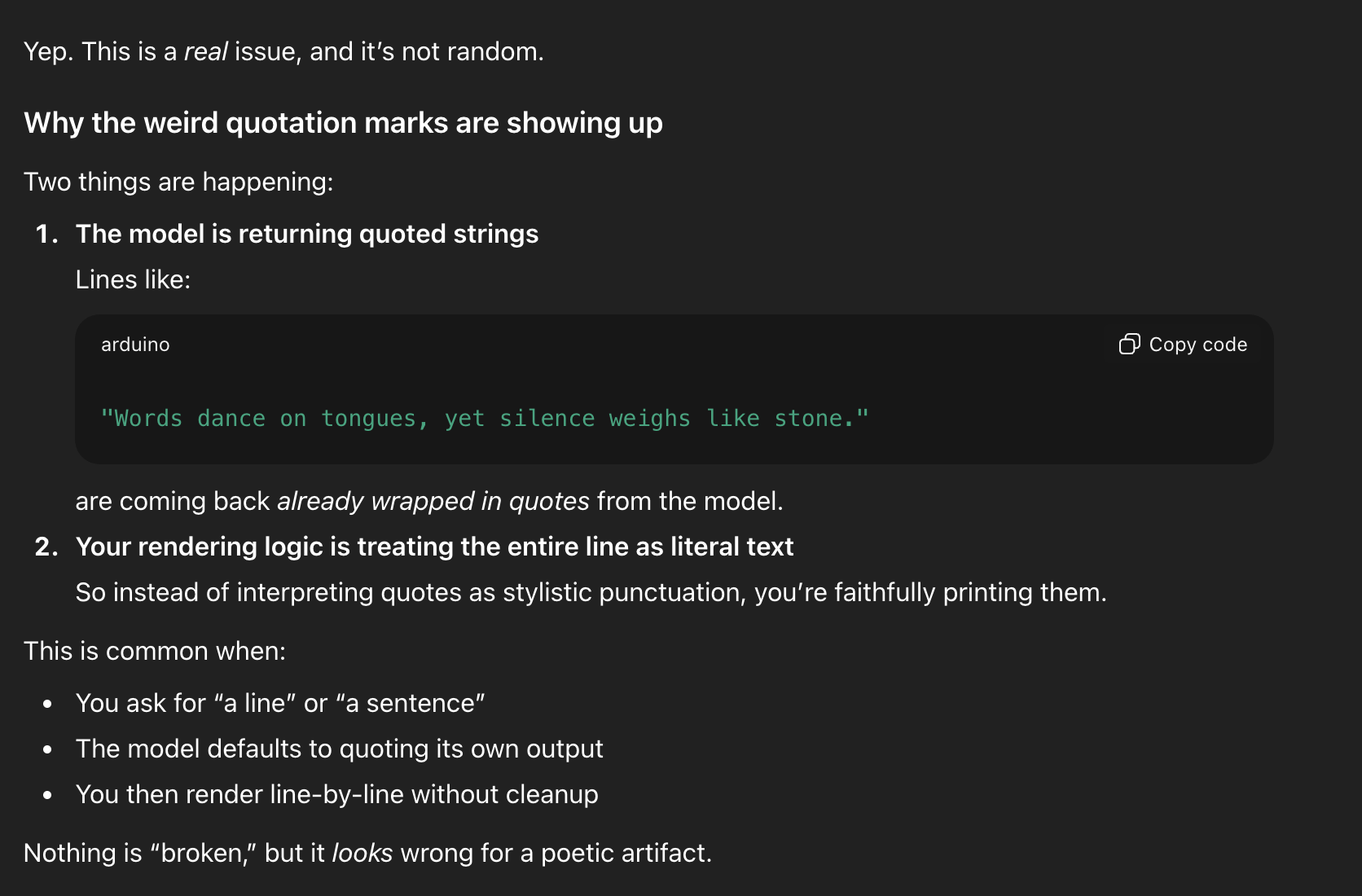
The new updated API now returns strings as "quotes" and when I went to see why, ChatGPT responded with: